

Texas license guide

Texas pest control license: how to get licensed, step by step.

In Texas, structural pest control is licensed by the Texas Department of Agriculture's Structural Pest Control Service. You need a business license for each location, a certified applicator behind it, and licensed techs doing the work. Here is the whole path, with the rule cited at every step.

Updated November 13, 2026. Rules read from the Texas Occupations Code ch. 1951 and 4 TAC ch. 7.

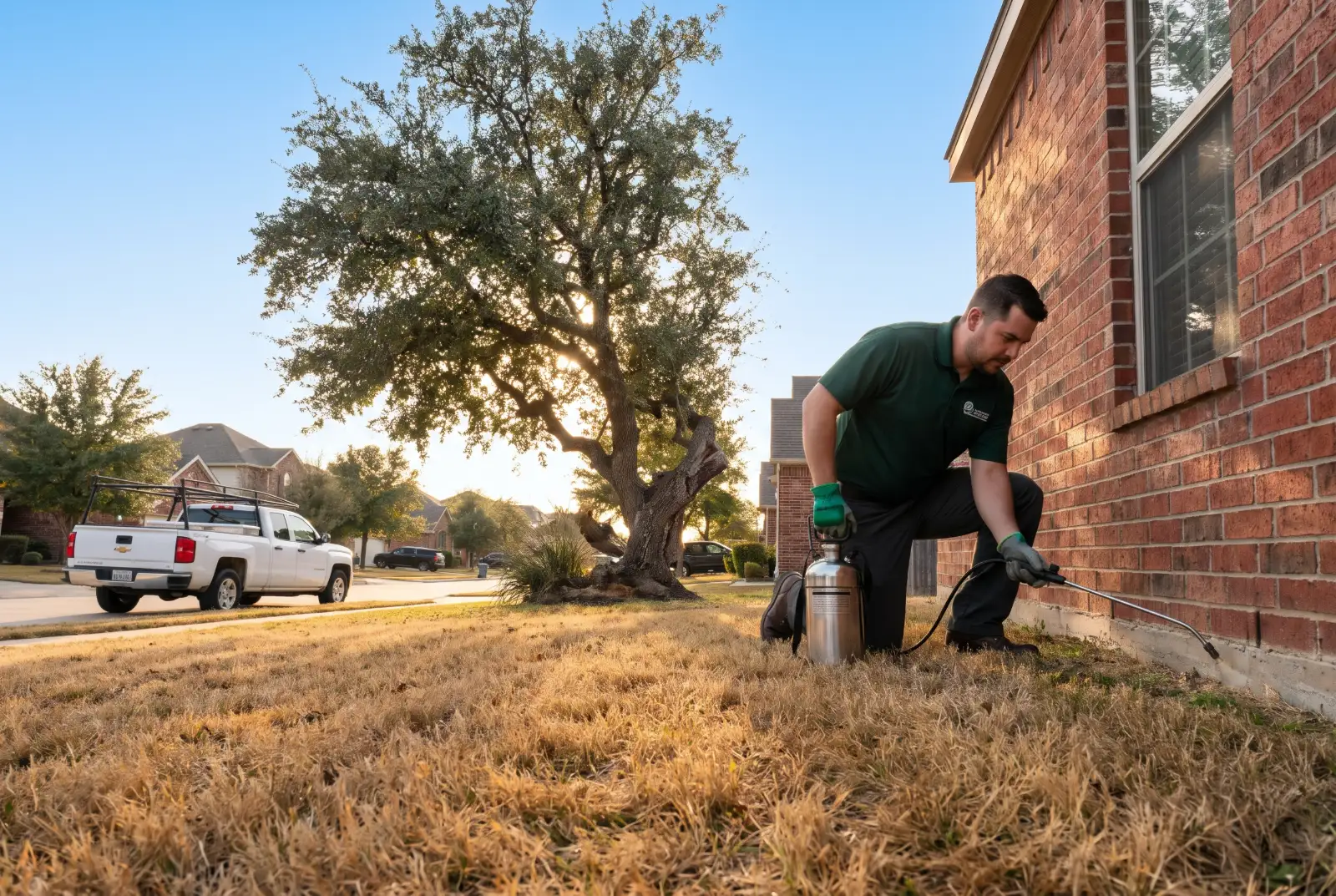
A pest control technician treats the foundation of a brick home in Texas, with his service truck at the curb.
At a glance

The Texas numbers that matter.

$300Business license, per location, per year4 TAC 7.128
$125Certified applicator or technician license, per year4 TAC 7.128
$500k / $1MMinimum liability insurance per occurrence / aggregate4 TAC 7.123
70%Passing score on each licensing exam4 TAC 7.125
12 of 24Months of supervised work before the certified applicator exam (the usual route)4 TAC 7.126
2 + 1Yearly CEUs: 2 general, plus 1 per category4 TAC 7.134
Who needs which license

Four credentials, and every pest control business needs at least two.

Business license

The company, one per location

Required to do or even advertise structural pest control for pay. Each branch office needs its own. The business must employ a certified commercial applicator at all times and name a responsible one for each location.

Occ. Code 1951.301 4 TAC 7.121

Certified commercial applicator

The licensed professional

Works without direct supervision in the categories they are certified in, and supervises technicians. Needs the general exam plus at least one category exam.

4 TAC 7.121(c), 7.126

Technician

Licensed techs on the route

Applies pesticides, uses devices, makes sales presentations and identifies infestations, under the direct supervision of a certified applicator, only in their licensed categories.

Occ. Code 1951.002(16) 4 TAC 7.121(f)

Apprentice

A new hire in training

A registration, not a license. At least 16 years old, registered within 10 days of starting, valid for 12 months while completing technician training.

4 TAC 7.132

The path

From new hire to running your own Texas pest control company.

This is the usual route for someone without a related degree. A biology-related degree, an out-of-state license or a past Texas certified license can shorten it.

  1. 1. Register as an apprentice

    Your employer registers you within 10 days of hire. Training done before the hire date does not count.

    4 TAC 7.132(d)

  2. 2. Complete technician training

    20 classroom hours across ten general subjects, plus 8 classroom hours and 40 on-the-job hours in each category you will work in, plus a 6-hour approved technician course.

    4 TAC 7.132(i), (m)

  3. 3. Pass the technician exam

    A score of at least 70% makes you a licensed technician. You then work under a certified applicator, who must be physically present at least one day a week.

    4 TAC 7.132(m) 4 TAC 7.133(b)

  4. 4. Build 12 months of experience

    At least 12 of the past 24 months working under a certified applicator, including at least 6 months holding a technician license.

    4 TAC 7.126(a)

  5. 5. Pass the certified applicator exams

    TDA pre-qualifies you, then you schedule with its exam provider. You need the general standards exam and at least one category exam, each at 70% or better. Category exams passed at the technician level do not carry over.

    4 TAC 7.126 TDA exams

  6. 6. Get insured and license the business

    File proof of liability insurance on TDA form ALS-1101, name yourself (or another certified applicator) as the responsible certified applicator, and apply for the business license. You may not do business or advertise until it is issued.

    4 TAC 7.123 TDA business license

  7. 7. Renew every year

    Business, applicator and technician licenses run 12 months. Certified applicators need their yearly CEUs to renew. Renewing more than 365 days late means taking the exams again.

    4 TAC 7.127 4 TAC 7.134

Categories

License only the work you do.

Texas licenses are issued in seven categories, and a business license only covers categories in which at least one of its certified applicators is licensed.

Pest Control

"The inspection or control of pests in and around structures ... but do not normally attack the building itself," such as cockroaches, ants, fleas, ticks, rats and mice. This is the category most general pest companies start with.

Termite and Wood Destroying Insect Control

"The inspection or control of termites, beetles, or other wood destroying insects ... in buildings," including termites in trees around structures.

  • Lawn and Ornamental
  • Weed Control
  • Structural Fumigation
  • Commodity Fumigation
  • Wood Preservation

4 TAC 7.124 4 TAC 7.121(a)

Insurance and fees

What it costs the state to let you open.

ItemAmountSource
Business license (each location, yearly)$3004 TAC 7.128
Certified applicator license (yearly)$1254 TAC 7.128
Technician license (yearly)$1254 TAC 7.128
Late renewal, up to 90 days1.5 times the fee4 TAC 7.128
Late renewal, 90 days to a year2 times the fee4 TAC 7.128
Liability insurance (minimum)$500,000 per occurrence, $1,000,000 aggregate4 TAC 7.123(a)

The statute sets a lower insurance floor ($200,000 / $300,000) but lets TDA set higher amounts by rule, and TDA has enforced the $500,000 / $1,000,000 rule since January 1, 2024. Exam fees are now paid to TDA's exam provider; check the current amount when you schedule.

Once you are licensed

Three rules that catch new owners.

Keep use records for two years

Every application needs a record: products and EPA registration numbers, amounts, target pest, date and who applied it, kept at the business for two years. 4 TAC 7.144

Free invoice and record template

Supervision has a schedule

A certified applicator must be physically present with a technician at least one day a week, and three days a week with an apprentice working alone. 4 TAC 7.143(b)

Unlicensed work is a crime

Each day of unlicensed work is a separate Class C misdemeanor (Class B for a repeat), plus civil penalties of $50 to $2,000 per violation per day. Occ. Code 1951.602, 1951.603

Questions

Texas license questions.

Can I start a pest control business in Texas without a license myself?

You can own the business, but it must hold a business license and employ a certified commercial applicator at all times, named as the responsible certified applicator for that location. Your techs need their own technician licenses. (Occ. Code 1951.301; 4 TAC 7.121)

How long does it take to become a certified applicator?

On the usual route, at least 12 of the past 24 months working under a certified applicator, including 6 months as a licensed technician, before you can take the certified applicator exams. A related biology degree or a prior license can qualify you sooner. (4 TAC 7.126)

Do I need a separate license for a second location?

Yes. Each place of business, including each branch office, needs its own business license and its own responsible certified applicator. (Occ. Code 1951.301(d); 4 TAC 7.121(a))

How much insurance do I need?

At least $500,000 per occurrence and $1,000,000 aggregate, filed on TDA form ALS-1101, and kept in force for the whole license period. (4 TAC 7.123)

What continuing education do I need?

Certified applicators need 2 general CEUs plus 1 per licensed category each calendar year, starting the year after the license is issued. Technicians need 8 hours of training a year. (4 TAC 7.133(d), 7.134)

Launching December 1, 2026

Be first on the route when RouteVectr opens.

Join before launch and $97 a month is locked in for as long as you stay. You get your setup link on launch day. We set everything up for you, and your 14-day free trial starts when it is live.

00Days
00Hours
00Min
00Sec

14-day free trial. No contract, cancel anytime. We'll email you when RouteVectr opens.